Skip to Royal Victorian Eye and Ear Hospital Primary Content

Skip to Navigation

About Us

Our History

Our History

A sense of history with a vision to succeed

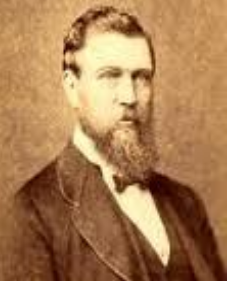
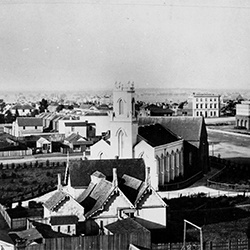
In 1863 while the American Civil War raged, an Irish immigrant doctor, Andrew Sexton Gray, established what was to become The Royal Victorian Eye and Ear Hospital. Melbourne was rapidly growing from the prosperity and confidence of Victoria’s gold boom. Into this burgeoning settlement came an influx of immigrants, including Dr Gray.

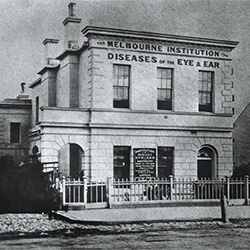
Dr Gray rented a house in Albert Street and, with just five pounds and one bed, started his infirmary to treat diseases of the eye and ear amongst Melbourne’s underprivileged. Three years’ later, and with the backing of others, he expanded his practice and opened the Melbourne Institution for Diseases of the Eye and Ear, a charitable institution run by a committee of management.

Even in its early days, the hospital was treating people from rural Victoria and interstate because it provided facilities not available elsewhere. Even acclaimed author and poet Henry Lawson travelled from Sydney to Melbourne for treatment of the hearing problems he had suffered since a child.

Just as today, eye diseases were more common than ear complaints, but whatever the complaint Dr Gray was committed to assisting people and went about his work with great energy. Only the poor were eligible for treatment but such was the hospital’s reputation even then that the wealthy were caught trying to masquerade as paupers to get treatment.

In 1873, Dr Gray’s institution merged with Dr Aubrey Bowen’s Ophthalmic and Orthopaedic Institution to become The Victorian Eye and Ear Hospital – 80 years’ later, in 1961, a Royal Charter was received which put the Royal into the name.

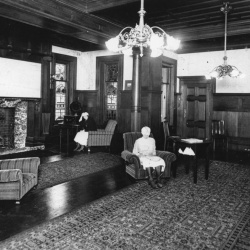
Today, the Hospital is more affectionately called just the Eye and Ear by its patients and staff. While the average stay for patients today is one day, in the early 1900s it was several months. No wonder then that the Matron of the day found she had a problem with absconding inpatients. In 1915, she wrote: “The patients are breaking hospital bounds by climbing over the fence and through the hedge. I had a barrier of barbed wire put across one corner, but this morning found they had broken through in a fresh place.”

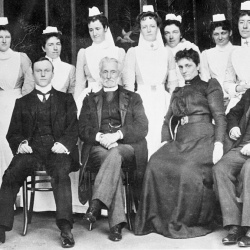
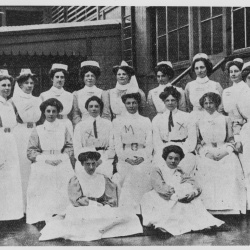
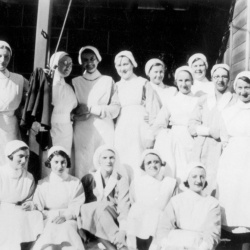
In 1916, the Inspector of Charitable Institutions praised the heroism of Eye and Ear nurses who often cared for people with highly infectious diseases. “They have faced a deadly unseen enemy but not one of them flinched from facing the ordeal,” he wrote.

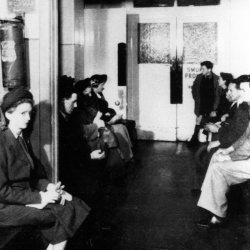
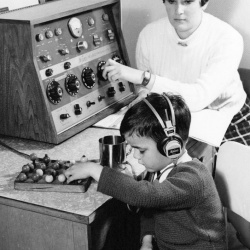
The 1950s and ‘60s were seen as a turning point for the hospital as its reputation and profile grew as it was recognised for its modern and often unique equipment, specialist staff, teaching and research. It was an era of expansion – the pathology department, Deafness Investigation and Research Unit, the Glaucoma Investigation and Research Unit, the Library, the Clinical Photography Department, the Eye Bank, Speech Therapy, and the Chair of Ophthalmology were all being planned and realised. A Research Advisory Committee was also formed in 1958 to encourage and promulgate hospital research.

Along with all the developments in treatment – antibiotics, new drugs and new techniques – new equipment also revolutionised the hospital.

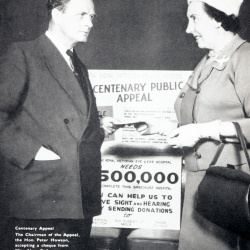
The early 1970s finally saw a major building program, with the completion of the Peter Howson Wing and shortly thereafter the planning for the Smorgon Family Wing, completed in the early 1980s. The 70s also ushered in a world first for the Hospital, the successful implantation of a Bionic Ear. The Bionic Ear was developed by Distinguished Professor Graeme Clarke AC and his researchers with the first implant in 1978. All Victoria’s bionic ear surgery is performed here.

The Hospital is approaching 150 years of service in 2013. It will also undergo a major redevelopment. A lot has changed since our beginnings in 1863 but what has remained constant has been how Dr Gray’s vision has lived on through us all.